Managing Reviews Across Multiple Locations Without Losing Your Days to It
Updated on 9 September 2026
Past 2-3 locations, manually responding to reviews on every Google listing becomes a workload that never shrinks, without ever becoming a real strategic priority. The fix isn't centralizing everything — some elements need to stay local — but clearly separating what gets managed at the network level from what stays specific to each location.
What should stay centralized
Tone and response style. A shared response charter (see standardizing review responses at scale) guarantees brand consistency, regardless of who manages each location day to day.
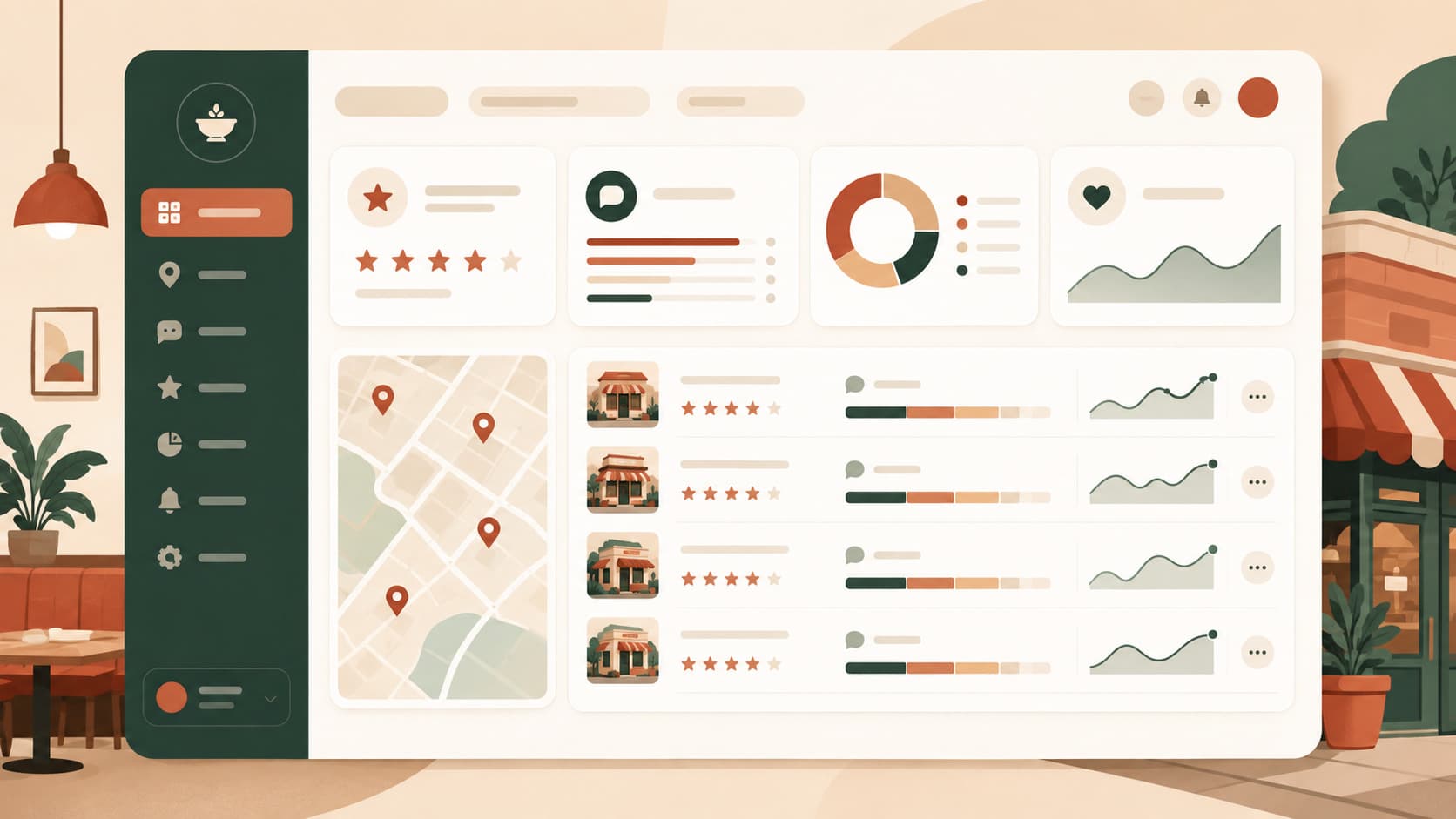
Reporting. A single dashboard aggregating average rating, review volume, response rate, and response time across the whole network lets you spot the location that's falling behind quickly, without waiting for a manual report.
Automating responses to positive reviews. 4-5 star reviews follow a repetitive pattern — handling them automatically frees up time for what actually matters: negative reviews.
What should stay local
Handling negative reviews. A response to a 1-3 star review needs real context (the incident, the customer, who was on shift that day) that only the manager of that specific location has. Automating this response is risky — see what never to do.
Local SEO keywords. The neighborhood, specialties, and quirks of each location need to show up in that location's responses specifically, not in a generic template replicated everywhere — see restaurant keywords that actually convert.
Hours and practical information, specific to each address.
An organizational model that scales
| Network size | Recommended setup |
|---|---|
| 2-3 locations | One owner, centralized tracking tool, still largely manual handling |
| 4-10 locations | Automated positive responses, automatic escalation of negatives to the right local manager |
| 10+ locations | Per-location cascade settings (tone, keywords, escalation thresholds), consolidated reporting at HQ level |
The risk of over-centralizing
A response generated from headquarters, with identical tone and vocabulary across every location, ends up reading as artificial — customers notice a repeated pattern from one location to another, especially if they visit several branches of the same brand. Centralization should apply to the process, not to the final content of each response.
For the budget math at this scale, see benchmarking local performance across your locations.
SEOresto offers per-location cascade settings with consolidated reporting — custom Réseau pricing from €199/month for chains of 3+ locations. See pricing.
Author: Dmitrii Portnov, founder of SEOresto.