Responding to Negative Reviews: A 5-Step Method
Updated on 22 August 2026
In short
- The method is five fixed steps: cool off → thank → name the fact → explain without justifying → move off the public square.
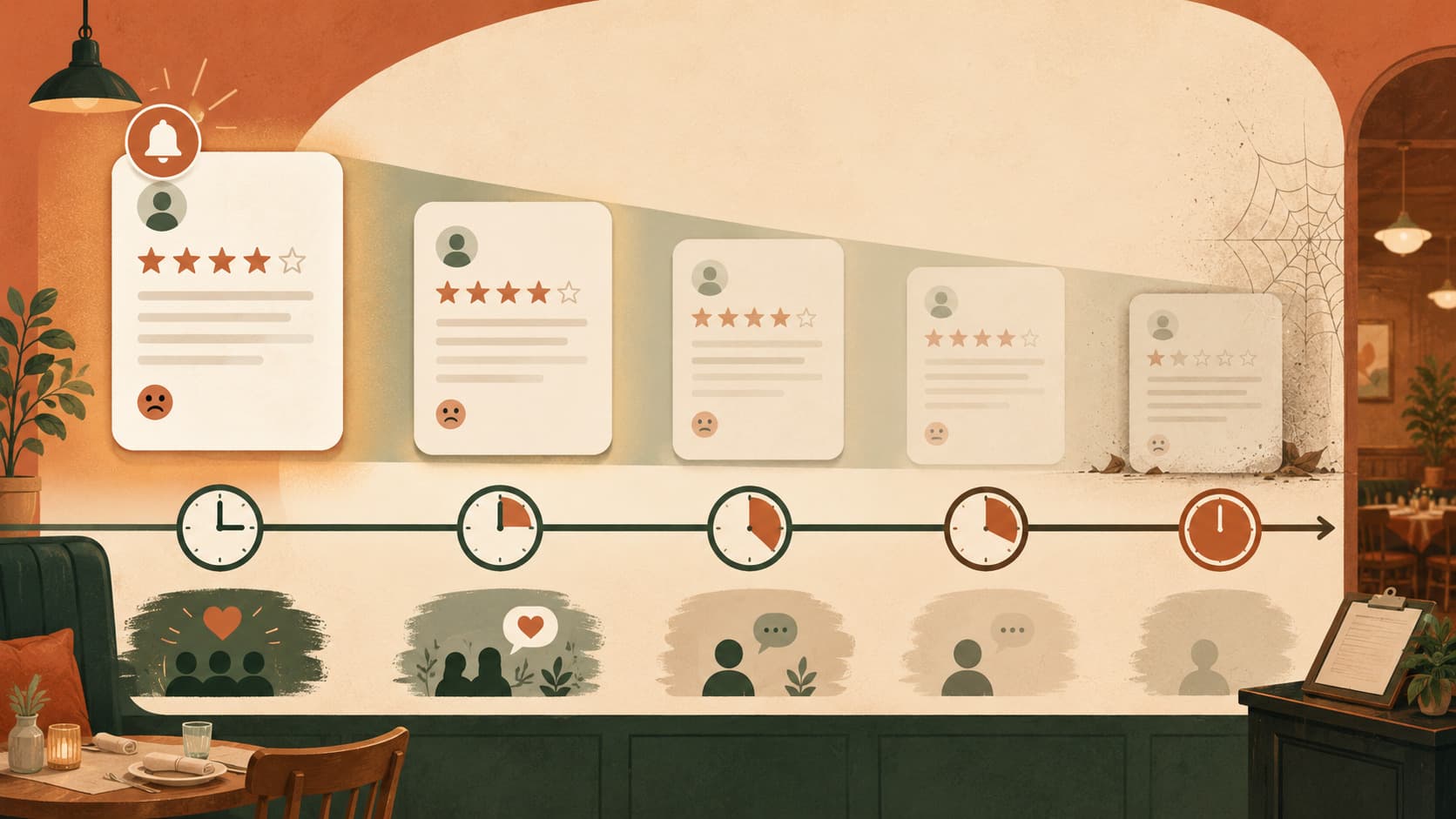
- Your target reader isn't the person who wrote the review — it's the next hundred people who will read your response.
- A calm reply to a harsh review often reassures more than a run of silent 5-star ratings.
- Never reply the same day while still annoyed — reading it back the next morning almost always changes the wording.
- Target timing: within 24 hours, not within 24 minutes.
Why the method matters more than writing talent
A negative review triggers a legitimate emotional reaction: you put work into that service, and someone is publicly criticising it. Responding while still feeling that reaction almost always produces a defensive reply, which makes the impression worse instead of fixing it.
The method exists specifically to get past the emotion and back to the fact. It works in roughly 95% of situations because it treats every review the same way, regardless of how it feels to read it.
Step 1 — Cool off, don't reply the same day
Simple rule: never within the hour after reading it. A response written while still annoyed is instantly recognisable — clipped tone, overlong sentences, the urge to "put things in context".
The right rhythm: read the review, let it sit for a few hours, reply the next morning at the latest. The 24-hour target is still comfortably achievable with that pause built in.
Step 2 — Thank them, without irony
The first sentence needs to be a genuine thank-you, not a formula that gives away your irritation.
| ❌ Ironic | ✅ Genuine |
|---|---|
| "Thank you for this constructive comment" | "Thank you for taking the time to write" |
| "We note your remark" | "Thank you for this feedback, it's helpful" |
| "Thanks for visiting anyway" | "Thank you for coming, and for telling us" |
A reader comparing your responses spots irony in one sentence. It costs more than it earns.
Step 3 — Name the specific fact, not the impression
This is the step most often botched. The temptation is to respond to the customer's emotion ("we're sorry you were disappointed") rather than to the fact they described ("you waited 40 minutes").
Naming the fact shows you actually read the review, rather than generating a formula.
Concrete example:
Review: "Served cold, and the bill was wrong too. Never seen that before."
❌ "We're sorry your experience didn't meet your expectations."
✅ "Cold food and a bill that didn't match what you ordered — those are two mistakes on our end, and there's nothing to add."
The second reply proves, in one sentence, that the message was read and taken seriously.
Step 4 — Explain without justifying
One sentence of explanation, not a paragraph of mitigating circumstances. The line between explaining and justifying comes down to one question: does the sentence describe what you are going to do, or what happened to you?
| Justifying (avoid) | Explaining (keep) |
|---|---|
| "We were slammed that night" | "We added a second server on Saturdays" |
| "The staff member was new" | "The team was retrained on this" |
| "We've never had this problem before" | "We reviewed the procedure" |
The difference isn't cosmetic. "We were slammed" places the cause on you but shows no change. "We added a server" shows a verifiable action.
Step 5 — Move off the public square when needed
Not every response needs a private follow-up. But as soon as there's a factual disagreement, a refund request, or a situation that deserves a gesture, the next step should leave the public comments.
"Email us at [email] — we'd like to understand exactly what happened."
That sentence does two things at once: it shows the next reader you take the situation seriously, and it avoids airing private details (amounts, staff names) in front of everyone.
The method applied: three real cases
Case 1 — A dish that never arrived (order error)
1-star review: "Ordered the tartare, never came. Asked twice, nothing. Paid for it anyway because the server was in a rush."
Response:
Hello [Name], a dish that never arrives and a bill that doesn't match — that's a double mistake on our end, and I understand the frustration. We've reviewed how orders move through the floor since. Email me at [email] with the date of your visit and I'll refund that dish directly.
Case 2 — Room felt too loud
2-star review: "Great food but impossible to talk, the music was too loud and the tables are packed in."
Response:
Thank you, [Name], and glad the food landed. [Day] nights the room is genuinely livelier — that's intentional, but it doesn't suit every occasion. If you come back, ask for the window table when you book; it's noticeably quieter.
Case 3 — Review alleging a hygiene issue
1-star review: "Found a hair in my food. Never again."
Response:
Hello [Name], thank you for flagging this — it's the kind of feedback we take very seriously. The protocol was reviewed with the entire kitchen team on [date]. I'm sorry this happened here, and I'd like to talk directly: email me at [email].
The five mistakes that undo all the work
- Replying the same evening. Reading it back the next morning almost always changes the response — for the better.
- Disputing the facts publicly. Even if the customer is wrong, a public dispute backfires. Take it private for that.
- Mentioning an amount spent. Never include personal figures in a public response.
- Copy-pasting the same structure across ten reviews. Readers who browse multiple responses notice, and so does Google.
- Not closing the loop. If the customer replies to your response and you leave it unanswered, the final impression is worse than the original review.
How long does this actually take?
With the method in mind, responding to a negative review takes 3 to 5 minutes, proofreading included. That's a bit longer than a positive review (2 minutes), and that's appropriate — it's the one that matters most.
Above 30 reviews a month, or across multiple locations, manual handling like this becomes a real time sink. SEOresto generates responses following exactly this method, in your restaurant's tone, with your local keywords naturally integrated. From €39/month. See pricing.
For 40 more templates sorted by situation, see how to respond to Google reviews: 40 templates. For the full subject, see the complete guide to Google reviews.
Source: Google's official review policies.
Author: Dmitrii Portnov, founder of SEOresto.