Platforms to List Your Restaurant On, and Which to Prioritize
Updated on 12 September 2026
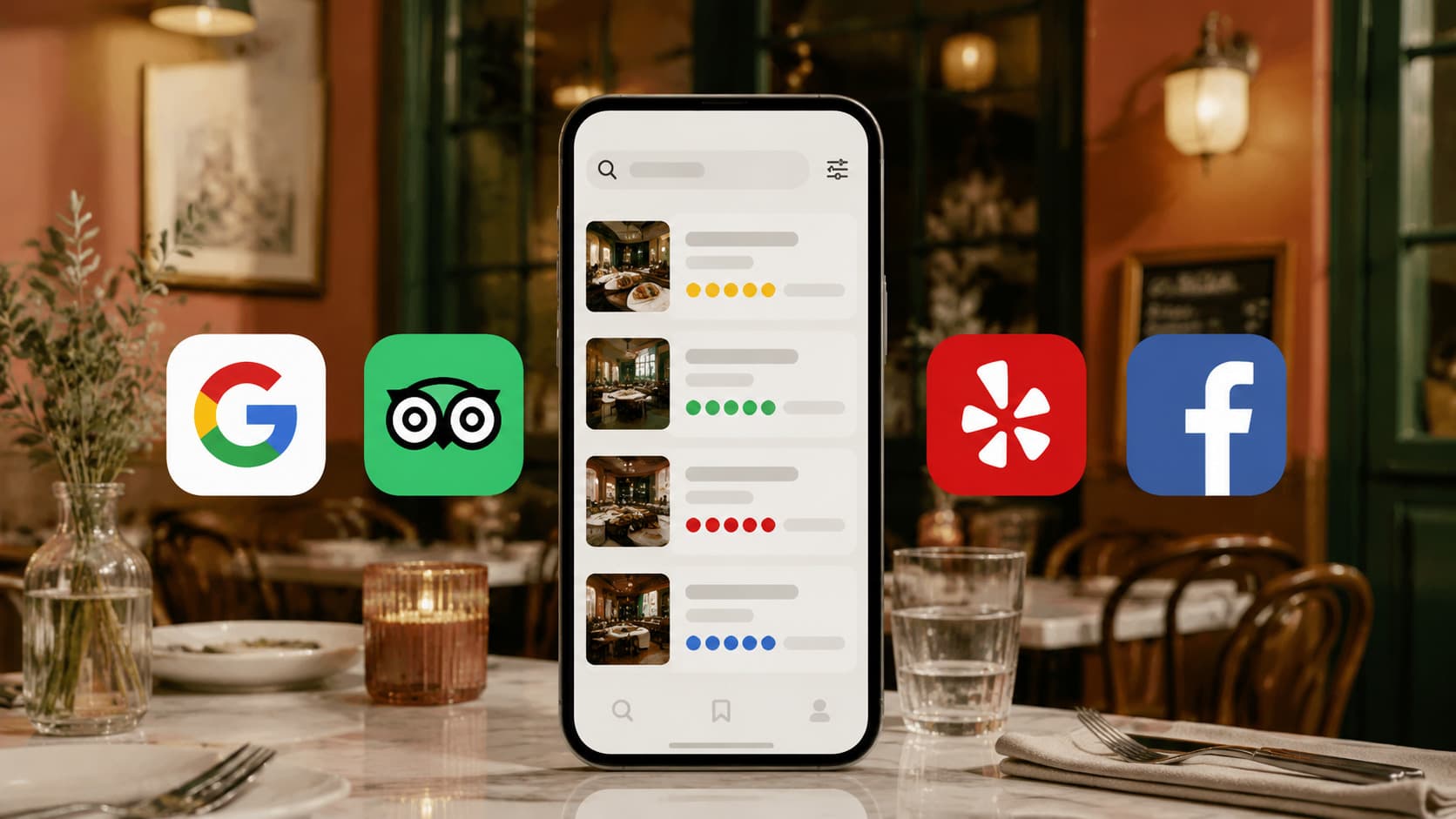
A restaurant can technically be present on dozens of platforms, but they don't carry equal weight. Google remains essential for local SEO and immediate conversion; the others play complementary roles depending on the type of customer you're targeting.
The role of each major platform
| Platform | Main role | Priority for an independent |
|---|---|---|
| Google Business Profile | Local SEO, immediate conversion, essential | Maximum |
| TripAdvisor | Tourist discovery, detailed reviews | High if tourist-facing |
| TheFork | Social proof tied to an actual reservation | High if online booking matters |
| Recommendations, local community social proof | Medium | |
| Visual discovery, not really a review channel | Medium, see Instagram and Google rankings | |
| Local directories (Yellow Pages equivalents) | Complementary local visibility, contact info and hours | Low to medium |
| Uber Eats / Deliveroo | Rating tied to delivery, visibility within the marketplace | High if delivery is a significant share of revenue |
| Apple Maps / Bing Places | Visibility for iPhone users / Bing search | Low, but free to set up |
Why Google dominates
Google Business Profile is the only platform where the listing appears directly in search results and on Maps, without the user needing to install an app or know the platform's name. It's the near-mandatory checkpoint before a decision, which is why nearly all resources should be concentrated there first — see local SEO for restaurants: the complete guide.
How to prioritize beyond Google
If your customer base is mostly tourist or international, a platform like TripAdvisor deserves real time investment — see TripAdvisor reviews: what still matters.
If online booking is a significant channel, TheFork complements Google well, since its reviews are tied to an actual booking, which strengthens their perceived credibility — see TheFork reviews: how they actually work.
If delivery represents a significant share of revenue, your rating on delivery apps has a direct effect on ranking within those apps — see delivery platform ratings and visibility.
The trap of spreading yourself too thin
Trying to actively manage fifteen platforms with limited time usually produces shallow management everywhere, rather than rigorous management on the 2-3 platforms that actually matter for your specific business. It's better to be present everywhere (accurate, consistent information) but active only where the return is real.
To centralize updating your information across multiple platforms, see presence management: one update, 50 platforms.
SEOresto focuses on Google, the platform that matters most for local conversion. From €39/month. See pricing.
Author: Dmitrii Portnov, founder of SEOresto.