Local SEO for Restaurants: The Complete Guide
Updated on 1 September 2026
In short
- Local ranking rests on three pillars: relevance, distance, prominence. Reviews account for roughly 17% of prominence.
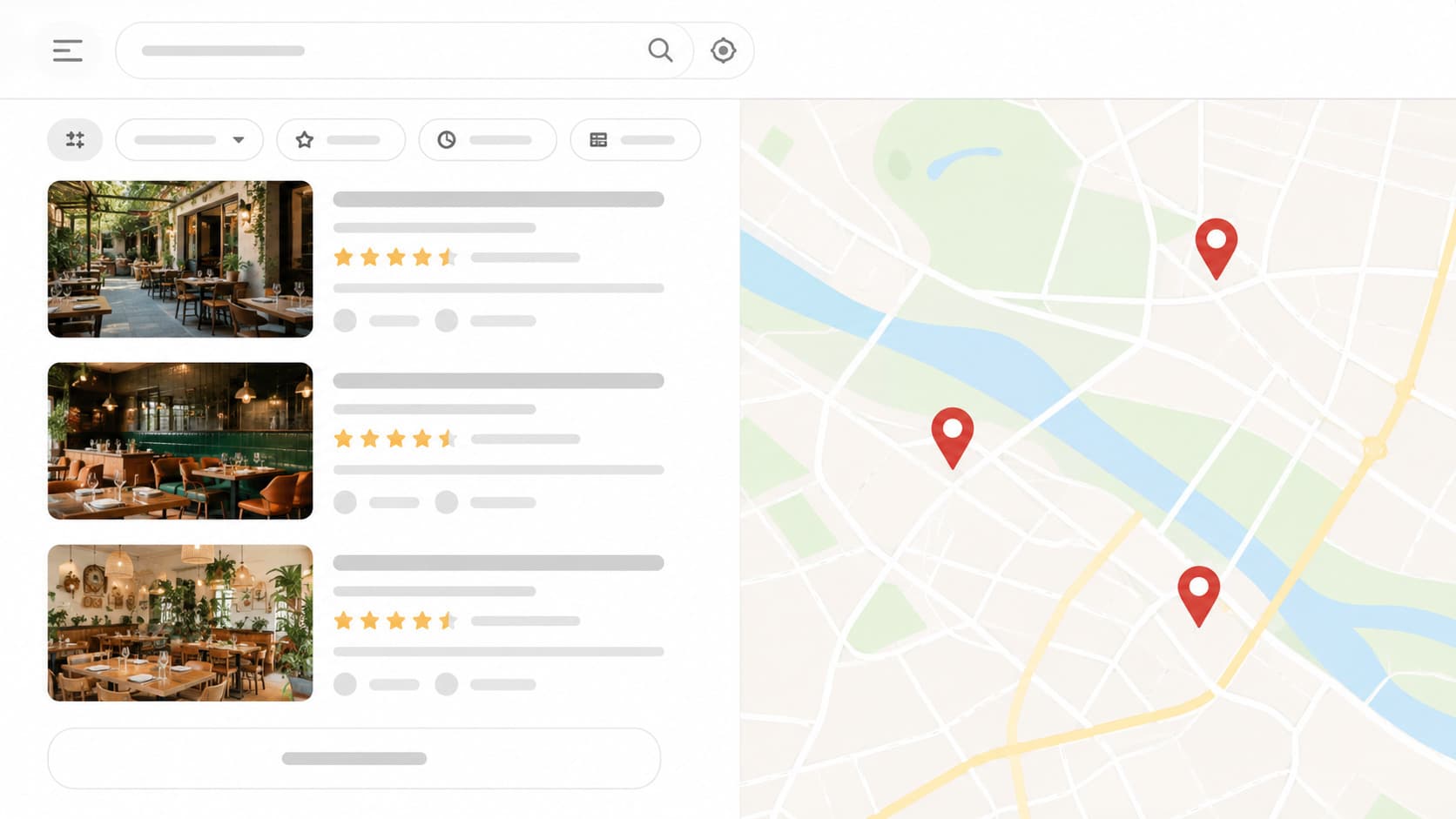
- The Local Pack (the block of three businesses with a map) captures roughly 42% of clicks in local search.
- On a "near me" query, the top 3 captures up to 75% of clicks.
- The effect of optimizing your Google Business Profile listing shows up in 2 to 6 weeks. The effect on organic results outside the Local Pack takes 2 to 4 months.
- In 80% of cases, the main issue behind a poorly-ranked restaurant is NAP consistency (name, address, phone) or a lack of freshness.
What Google actually evaluates
Google ranks local results on three declared criteria, in this order of stated importance:
- Relevance — how well your listing matches the search performed.
- Distance — how far you are from the search location (or the specified location).
- Prominence — your overall reputation, online and offline.
Prominence is the only one of the three you can meaningfully influence without relocating or changing your name. It combines: review volume and freshness, your average rating, your responses to reviews, how complete your listing is (photos, posts, up-to-date attributes), and external signals (mentions, citations, local backlinks).
The real weight of reviews
2026 industry analysis puts the weight of reviews at roughly 17% of local ranking. That's neither negligible nor dominant — it's one factor among several, but it's the only one you feed continuously through normal operations, without technical SEO work.
Three elements matter within that factor: the volume of recent reviews, the average rating, and the owner response rate. Full detail, with the collection and response method, is in our complete guide to Google reviews.
What a good position actually delivers
| Position | Share of clicks captured |
|---|---|
| Local Pack (top 3 with map) | ~42% of local search clicks |
| Top 3 on a "near me" query | up to 75% of clicks |
| Classic organic results outside the Local Pack | residual share, sharply lower |
These figures explain why the Local Pack is the priority target for a restaurant — well ahead of classic organic ranking, which captures a fraction of traffic on a local query.
The 6 levers, ranked by impact
1. Complete, up-to-date Google Business Profile listing
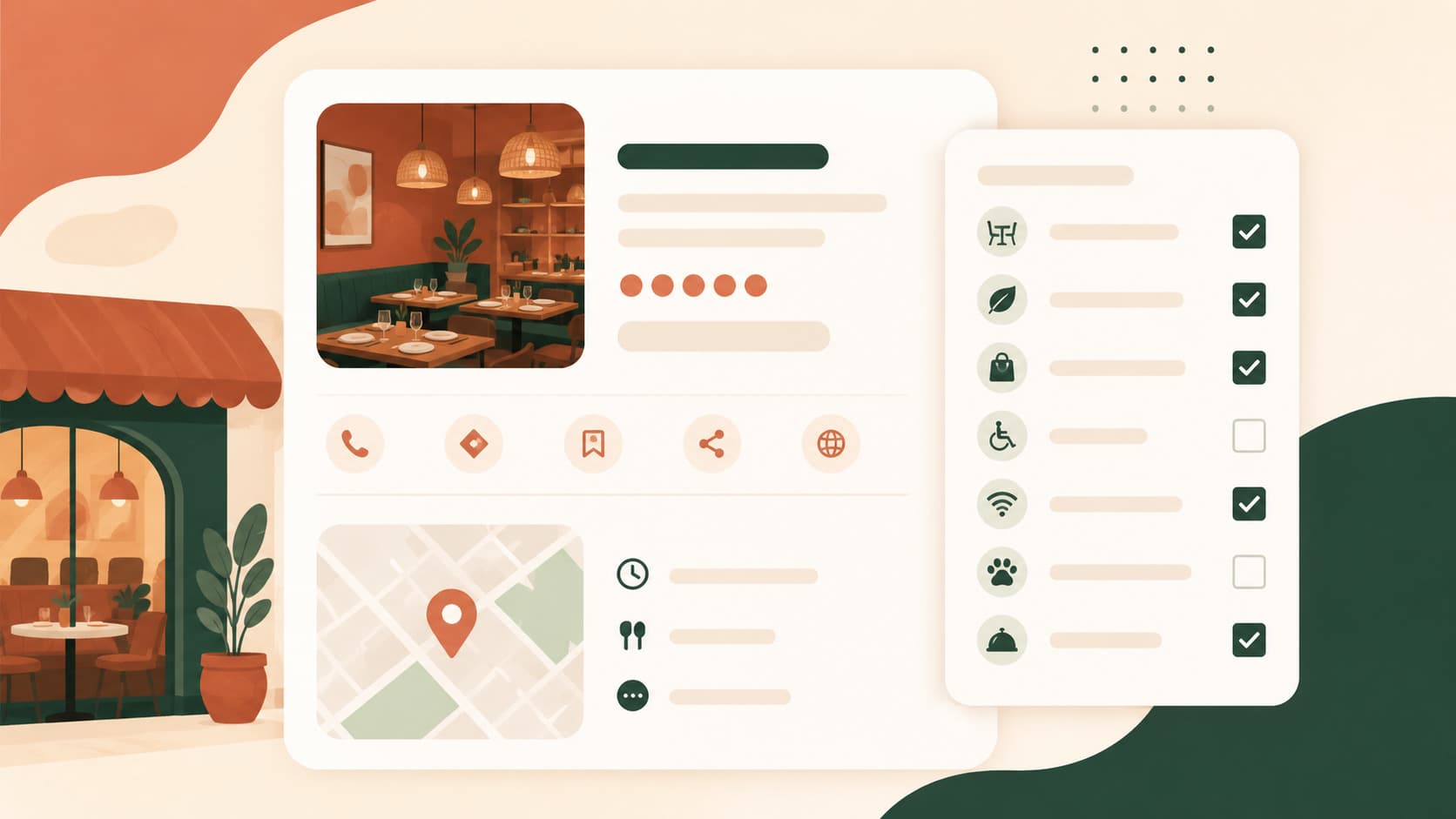
This is the foundation. An incomplete listing (wrong category, missing hours, no description) loses relevance before reviews even come into play. Full detail on the 16 points to check is in Google Business Profile: 16 optimizations.
2. NAP consistency (Name, Address, Phone)
In 80% of observed poor-ranking cases, the problem traces back to inconsistency between your Google listing and mentions of your business elsewhere on the web (your own site, directories, social media). Full detail is in NAP consistency: why a comma costs you customers.
3. Reviews: volume, freshness, responses
See the section above and the complete guide to Google reviews.
4. Activity freshness
A listing that publishes Google Posts regularly, adds photos, and keeps hours current signals real activity to Google. A listing frozen for a year loses prominence, even with a good rating.
5. Keywords in listing content
The description, categories, and even review responses are places where relevant keywords (specialty, neighborhood) strengthen the association between your business and those search terms. See restaurant keywords that actually convert.
6. Citations and external presence
Your name, address, and phone consistently mentioned across other sites (directories, local press, partners) build prominence. This is the slowest lever to activate, but the most durable.
How long before you see a result
| Action | Observed timeline |
|---|---|
| GBP listing optimization (category, hours, photos, attributes) | 2 to 6 weeks |
| Accumulating recent reviews (steady pace) | 4 to 8 weeks for a measurable effect |
| Organic ranking outside the Local Pack (website, content) | 2 to 4 months |
| Citations and external presence | 3 to 6 months for a consolidated effect |
The gap between these timelines is why you need to work several levers in parallel: the GBP listing gives a fast result, reviews and citations build an advantage that lasts.
Where to start in practice
- Check your listing is complete — see the 16-point guide.
- Search your main query in a private window and note what separates you from the top 3 (see how many reviews to rank in the local top 3).
- Check your NAP consistency across at least 5 sites where your business is mentioned.
- Restart review collection if it's stalled — see 12 legal ways to get more Google reviews.
- Publish a Google Post this week, even a simple one.
Frequently asked questions
Is local SEO different from classic SEO?
Yes. Classic SEO optimizes for ranking in global organic results. Local SEO specifically optimizes for the Local Pack and Google Maps, with its own factors (distance, reviews, GBP listing) that don't exist in traditional web SEO.
Do you need a website to rank well locally?
No, it's not essential. A Google Business Profile listing works as a standalone entity. A website helps with classic organic SEO and credibility, but a restaurant can rank well in the Local Pack without one.
How much does good local SEO cost?
The listing and reviews side is free in terms of your own time, or €39-49/month with a self-service tool. See the software comparison.
To go deeper on each lever, see how to rank in the Google Maps top 3, Google Business Profile in 16 points, and the complete guide to Google reviews.
SEOresto works directly on the reviews lever — the fastest to activate — with automated responses that integrate your local keywords. From €39/month. See pricing.
Sources: industry analysis on local ranking factors, 2026.
Author: Dmitrii Portnov, founder of SEOresto.