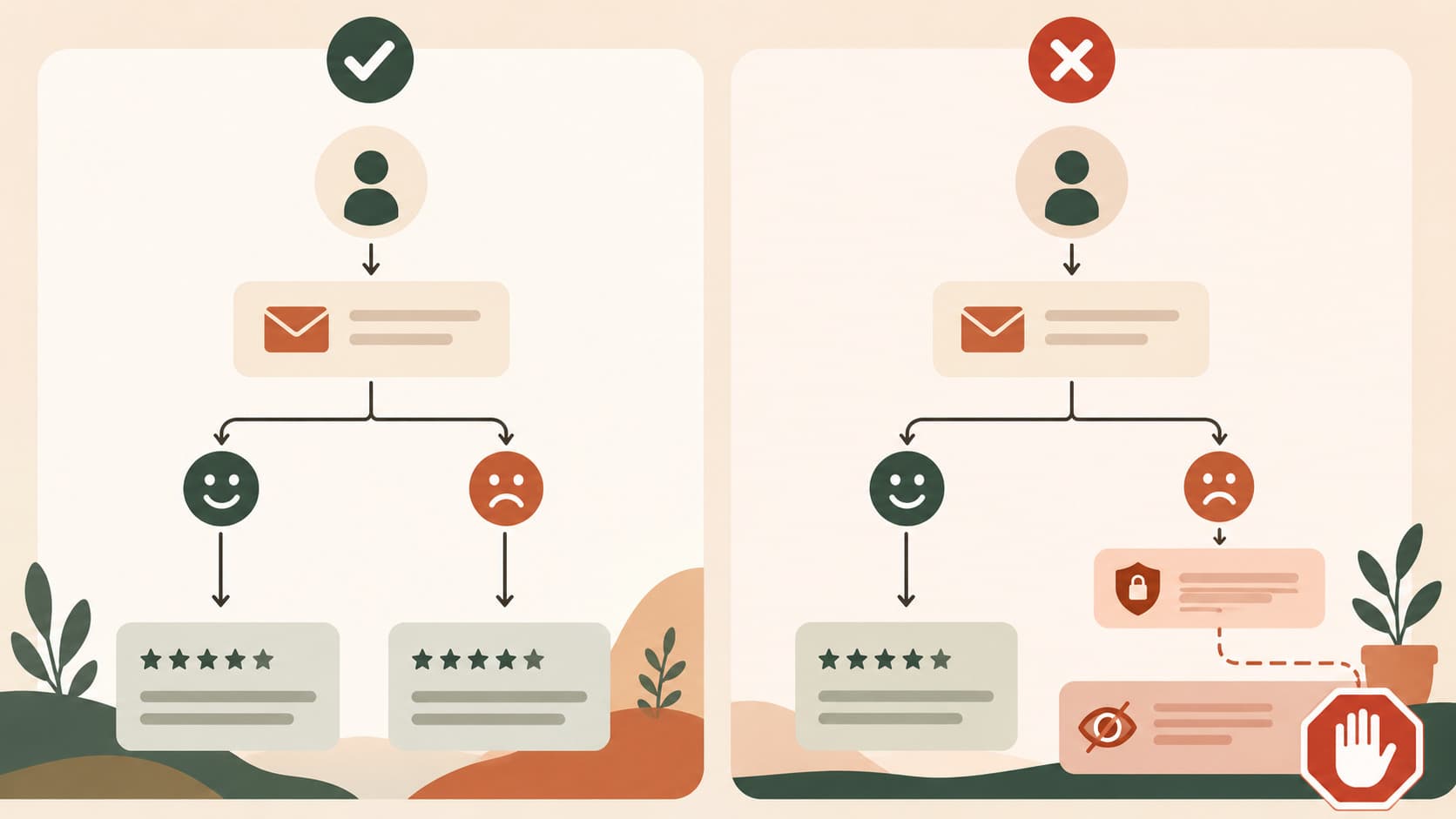
Review Gating Is Illegal in the US: The FTC Rule Explained
Updated on 23 August 2026
In short
- Review gating — steering satisfied customers toward Google and unhappy ones elsewhere — is explicitly banned by the FTC's Rule on the Use of Consumer Reviews and Testimonials.
- One US company paid $4.2 million in penalties in 2022 for this exact practice.
- The test isn't what you call the feature — it's the actual flow: is the Google link shown to everyone, or only to some?
- What stays compliant: show the Google link systematically, to every customer, and add an internal feedback channel on top of it, never instead of it.
- This isn't only a compliance question. Consumer trust data on businesses that respond to all reviews, including negative ones, makes the honest approach a selling point, not just a constraint.
What the FTC rule actually says
The FTC's Rule on the Use of Consumer Reviews and Testimonials, finalized in 2024, makes several practices unlawful, with civil penalties per violation. The one most relevant to review software is explicit: it is illegal to misrepresent that reviews on a platform represent all or a random sample of customers when the process has been set up to suppress negative ones.
In practice, this covers:
- a system that asks "were you satisfied?" first and only shows the Google review link if the answer is yes;
- a flow that redirects unhappy customers to an internal form instead of Google;
- staff instructed to ask for a review only from customers who seem happy;
- a different QR code depending on the table, the server, or the perceived outcome of the meal.
It doesn't matter what the feature is called — "quality filter," "pre-screening," "feedback loop." The FTC looks at what the system does, not its marketing label.
The $4.2 million precedent
In 2022, a US company was fined $4.2 million by the Federal Trade Commission for operating a system that routed unhappy customers to a private form instead of public review platforms, while actively pushing satisfied customers to post publicly.
This case became the reference point cited across the industry — including by direct competitors selling review management tools. The topic is already documented and known to the restaurant owners you're targeting. Someone searching "filter negative reviews" before buying a tool will find this story before they find your product.
What stays legal: the exact line
The test comes down to one question: does a customer who had a bad experience see the same Google link as one who loved their meal?
If yes — the flow is compliant. If no — it's review gating, regardless of presentation.
| Element of the flow | Compliant | Not compliant |
|---|---|---|
| Google link shown | To everyone, no exceptions | Only to "satisfied" customers |
| Pre-screening question | None, or asked after the link is already shown | Used to gate whether the link appears |
| Internal channel | Offered in addition to the Google link | Replaces the Google link for some customers |
| Staff instructions | Same for every customer | Different depending on perceived mood |
What works, in practice
The setup that stays compliant and still meets the real need — catching dissatisfaction before it becomes a 1-star review, without blocking anyone — looks like this:
- The QR code (on the table, the receipt, a post-visit text) opens a single page, identical for everyone.
- On that page: the link to the Google review, visible immediately, not hidden behind a question.
- Just below or beside it: "Got feedback for us directly?" with a short form.
- The customer chooses freely: leave the Google review, fill out the internal form, do both, or do nothing.
Nothing is clicked on the customer's behalf. Nothing is hidden based on what they just answered. That's the difference between steering (illegal) and offering an additional channel (legal).
Why marketing writers walk into this trap
The mistake almost always comes from the same place: someone wants to sell a feature that "reduces negative reviews," and the simplest way to build it technically is to gate the Google link behind a prior answer. It's intuitive to code, and it works — until it's flagged or reported.
A second source of error is vocabulary. "Negative review filter" describes exactly what the FTC prohibits, even when the underlying intent — resolving dissatisfaction quickly — is legitimate. The name of the feature matters in internal documentation, terms of service, and potentially in a dispute — not just in marketing copy.
How to audit an existing tool or process
Five questions, in order:
- Do two customers — one delighted, one disappointed — see the same screen first?
- Is the Google review link visible before any satisfaction question?
- Is there a scenario where a customer never sees the Google link at all?
- Do staff get instructions that vary based on the perceived mood of the meal?
- Is the QR code identical across every table, every shift, every server?
If the answer to question 3 is yes, or question 1 comes back negative, the setup is non-compliant — regardless of what it's called.
What this changes beyond compliance
Beyond the penalty risk, there's a direct business argument: articles explaining review gating to restaurant owners already cite the $4.2 million fine and industry data on how much more consumers trust businesses that respond to every review, including negative ones (71% according to industry figures).
A restaurant owner who understands this distinction — and sees that a tool respects it explicitly — trusts the product more. Compliance here is a selling point, not just a constraint.
Frequently asked questions
Is a different QR code per table a problem by itself?
Not necessarily, if the content shown is identical for everyone. The problem appears when content changes based on criteria tied to expected satisfaction (for example, a VIP table routed differently).
Can you offer a discount in exchange for a review, positive or negative?
No. Offering compensation for a review is separately prohibited by both Google and the FTC, regardless of the gating question — covered in the complete guide to Google reviews.
Does an internal satisfaction survey replace asking for a Google review?
No, it adds to it. Replacing the Google review request with an internal survey for some customers is exactly the prohibited scenario.
What are the actual penalties?
The FTC rule allows civil penalties per violation, which can scale quickly for a business processing hundreds of reviews. Beyond the fine, Google's own terms treat gating as a policy violation, which can lead to a listing being demoted or suspended independently of any FTC action.
Sources: FTC Rule on the Use of Consumer Reviews and Testimonials · Google's official review policies.
Author: Dmitrii Portnov, founder of SEOresto. This article provides general information and is not legal advice.