Google Reviews for Restaurants: The Complete 2026 Guide
Updated on 20 August 2026
In short
- Reviews account for roughly 17 % of local ranking weight on Google: volume, freshness, rating and owner responses.
- No review can be deleted on request. Google only removes reviews that violate its policies.
- Offering anything in exchange for a review, or screening customers by satisfaction level, is prohibited and puts your listing at risk.
- Responding is the only lever fully under your control: 96 % of consumers read owner responses.
- Moving from 4.0 to 4.5 stars produces measurable revenue: Michael Luca's Harvard Business School research puts +1 star at roughly +9 % in revenue.
Why Google reviews decide how full your dining room gets
A Google review is not an internet comment. It is a ranking signal.
When someone searches "Italian restaurant near me", Google builds the Local Pack — the block of three businesses shown above the classic results — from three criteria: relevance, distance and prominence. Reviews feed directly into the third.
The orders of magnitude that matter, from 2026 industry analysis:
| Signal | Weight / observed effect |
|---|---|
| Reviews in local ranking | ≈ 17 % of total weight |
| Clicks captured by the Local Pack | ≈ 42 % of local search clicks |
| Clicks captured by the top 3 on a "near me" query | up to 75 % |
| Consumers who read owner responses | 96 % |
| Consumers who trust a business more when it responds | 71 % |
In short: half your potential customers judge you before they reach the door, and Google uses that judgement to decide whether to show you at all.
How does Google calculate your rating?
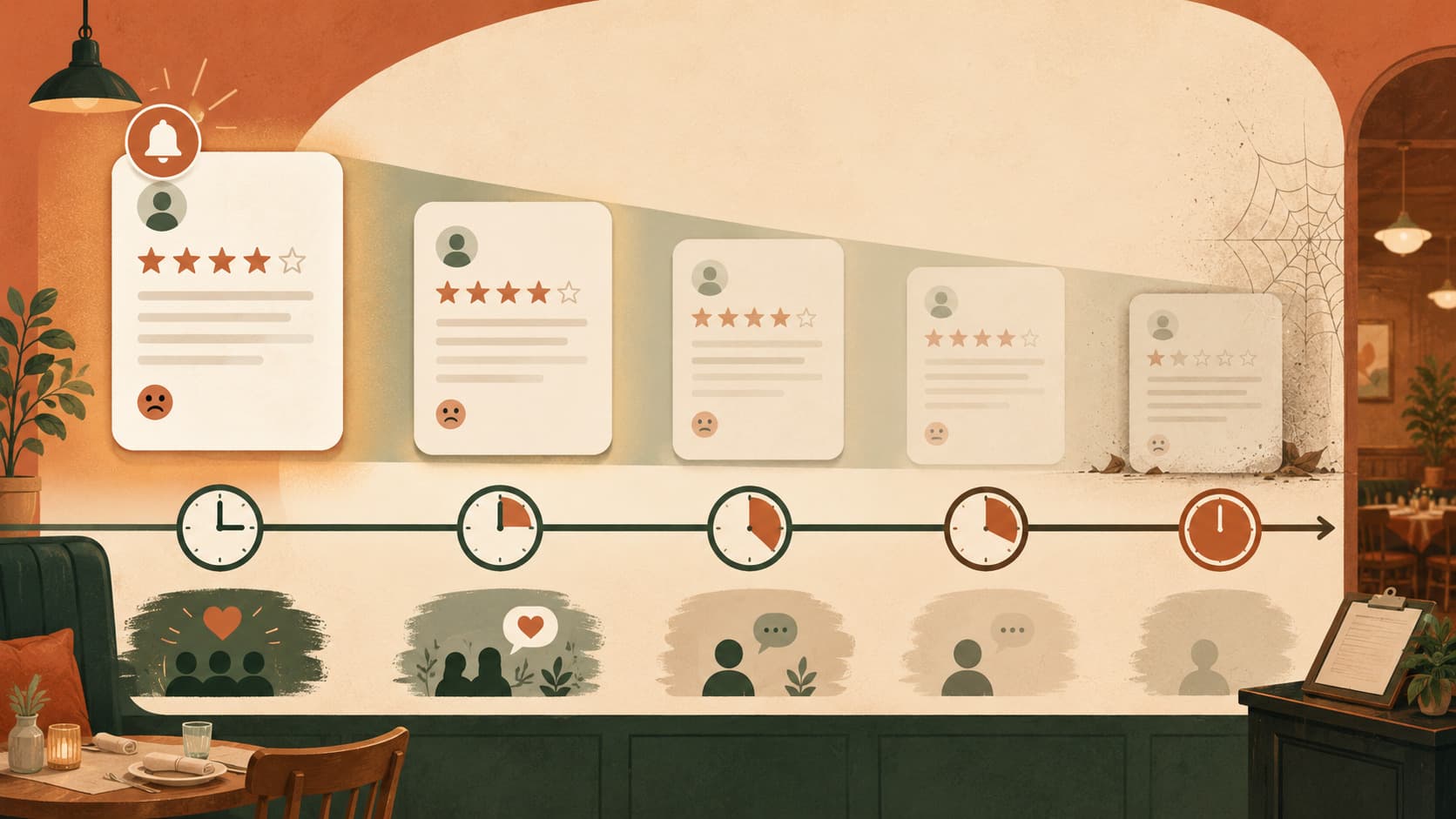
The displayed rating is a weighted average, not a simple arithmetic mean. Google gives more weight to recent reviews and to reviews written by active, trustworthy accounts. This is why a business at 4.2 with 40 very recent reviews can outrank a competitor at 4.4 with 300 dormant ones.
Three practical consequences:
- Freshness beats volume. Ten reviews this month are worth more than fifty from two years ago.
- An old bad review matters less and less. Time works in your favour as long as the flow continues.
- Stopping collection is visible to Google. A profile that receives nothing loses prominence.
How many reviews do you need to be visible?
There is no absolute threshold. The only useful benchmark is the average of the three businesses already ranking ahead of you on your main query.
The method, in five minutes:
- Search your target query in a private window: "Thai restaurant Brooklyn", for example.
- Note the review count and rating of the three businesses in the Local Pack.
- Average the review counts. That is your volume target.
- Note the lowest rating of the three. That is your quality floor.
- Check their most recent review date. That is the cadence you need to hold.
A neighbourhood spot in Austin faces different numbers than a Midtown Manhattan brasserie. The target is always local.
What exactly does Google say about collecting reviews?
Google's published policies are short and unambiguous. Three prohibitions structure everything else:
| Practice | Status | Consequence |
|---|---|---|
| Asking every customer for a review | ✅ Allowed | — |
| Offering a discount, dessert or gift for a review | ❌ Prohibited | Content removed, listing penalised |
| Soliciting only satisfied customers (review gating) | ❌ Prohibited | Penalties, and documented fines in the US |
| Buying reviews | ❌ Prohibited | Mass removal, lasting loss of trust |
| Asking employees to leave reviews | ❌ Prohibited | Content removed |
| A QR code linking to your listing, visible to everyone | ✅ Allowed | — |
The third point is the most widely misunderstood. A system that first asks "were you satisfied?" and only shows the Google link to those who say yes is a prohibited practice, whatever it is called. In the United States, the FTC's rule on consumer reviews makes this explicit — we cover the exact boundary in review gating and the FTC rule.
How do you get more reviews without breaking the rules?
The principle is simple: make the action easy and ask at the right moment, without ever conditioning the request on satisfaction.
Channels that work in restaurants, most to least effective:
| Channel | When | Note |
|---|---|---|
| QR code on the bill | at payment | The customer is still seated and in a good mood |
| Verbal request from the server | on departure | Highest rate, but depends on the team |
| Table tent or NFC sticker | continuous | Low unit cost, passive effect |
| SMS or email after the visit | 2–24 h later | Requires you to have collected the contact |
| Link in email signature | continuous | Marginal but free |
Three errors observed constantly:
- A QR code pointing to an intermediate page. Every extra screen loses customers. The link should open the Google review form directly.
- A QR code never tested on mobile. Test it yourself, on a phone not signed into your Google account.
- A request phrased as "leave us 5 stars". That is solicitation bias, and it is exactly what Google is built to detect.
Full details, including printable templates, are in our Google review QR code guide.
Should you respond to every review?
Yes, and it is the only lever entirely under your control. You do not choose what customers write; you choose what they read next.
Three reasons, in order of importance:
- Effect on the reader. 96 % of consumers read owner responses, and 71 % say they trust a business more when it responds. A 2-star review followed by a calm reply often reassures more than a run of silent 5-star ratings.
- Effect on ranking. Responses are part of the review signals Google takes into account. An active profile is a living profile.
- Semantic effect. Your response is indexable text attached to your listing. A reply that naturally mentions your speciality and neighbourhood — "thanks for coming to try our wood-fired pizzas in Williamsburg" — strengthens the association between your business and those terms.
That last point is the one almost nobody uses. This is not about stuffing responses with keywords: an artificial reply is immediately visible and damages your image. It is about writing naturally while naming what you do and where you do it.
How fast should you respond?
Within 72 hours for a positive review, within 24 hours for a negative one.
A negative review is read when it is most visible: in the days following publication, it sits at the top of recent reviews. A fast response therefore reaches the largest number of readers. Two weeks later, the same response will be seen by almost nobody.
How do you respond to a negative review?
The structure that works has four movements, and it is always the same:
- Thank them, without irony or empty formulas.
- Acknowledge the specific fact the customer raised. Not "we're sorry you felt that way", but "you waited forty minutes on a Saturday night, and that is too long".
- Explain without justifying. One sentence. What happened, what you are changing.
- Leave the public square. Offer direct contact for the rest.
What never to do: dispute the account publicly, mention how much the customer spent, invoke staffing difficulties, or reply the same evening while still annoyed.
Forty response examples sorted by situation — wait times, food, service, cleanliness, noise, ratings without text, obviously fake reviews — are collected in how to respond to Google reviews: 40 templates.
Can you delete a Google review?
No. There is no delete button, not for you and not for Google on simple request. You can only report a review that breaks the rules: off-topic content, hate speech, spam, conflict of interest, personal data, or a clearly fake review.
Success rates on reporting are low and the timeline runs in days or weeks. It is a remedy, not a strategy.
The only approach that works at scale is arithmetic: dilution. A 1-star review out of 40 drags the average down; the same review out of 400 is invisible. Full details on valid grounds and the reporting procedure are in you can't delete a Google review.
How do you spot a fake review?
The most reliable signals, in order of value:
| Signal | What it indicates |
|---|---|
| Account with no photo, no history, a single review | Profile created for the occasion |
| Very detailed review with nothing verifiable | Text written remotely |
| Several negative reviews within a few hours | Coordinated campaign |
| No trace of the visit (no booking, no ticket at that time) | Customer never came |
| Mentions a dish that is not on your menu | Wrong business or fabrication |
| Attached demand for money or compensation | Extortion — reportable and criminal |
In the United States, the FTC's Rule on the Use of Consumer Reviews and Testimonials makes buying, selling and suppressing reviews explicitly unlawful, with civil penalties per violation.
What should you actually measure?
Five indicators are enough. They fit in a table you fill once a month:
| Indicator | Reasonable target |
|---|---|
| New reviews per month | ≥ the Local Pack average on your query |
| Average rating | ≥ the lowest rating in the Local Pack |
| Response rate | 100 % |
| Median response time | < 48 h |
| Recurring themes in negative reviews | falling month over month |
The last one is the most useful and the least tracked. If "wait" appears in eight negative reviews out of ten this quarter, that is no longer a reputation problem: it is a floor operations problem, and your reviews flagged it for free.
Do you need software for this?
Below roughly thirty reviews a month on a single location, no. A spreadsheet, an alert and half an hour a week will do.
A tool becomes worth paying for once one of these three thresholds is crossed:
- more than 30 reviews a month to handle;
- more than one location;
- more than one platform to monitor in parallel.
The comparison of market solutions, with public prices recorded and dated, is in restaurant review software comparison 2026.
SEOresto responds to Google reviews automatically while naturally integrating your local keywords, publishes your Google Posts and centralises your online presence. From €39/month, no demo and no commitment. See pricing.
Frequently asked questions
Can you turn reviews off on a Google listing?
No. Reviews cannot be disabled on an active business profile. The only way to stop receiving them is to permanently close the listing, which would remove you from Google Maps.
Does a review with no text, just a star rating, count?
Yes, it enters the average like any other. You can still respond: a simple thank-you is enough and shows the profile is monitored.
Should you respond in multiple languages?
Respond in the language of the review where possible. In tourist areas this is a strong signal to the next readers, who are often in the same situation.
How long does a review stay visible?
Indefinitely, unless removed by its author or by Google for a policy violation. Its influence on your rating fades as new reviews arrive.
Is it worth responding to an old negative review?
Yes, but the effect is small. Always prioritise reviews from the last thirty days: those are the ones being read.
Sources: Google's official review policies · Michael Luca, "Reviews, Reputation, and Revenue", Harvard Business School · FTC Rule on Consumer Reviews and Testimonials.
Author: Dmitrii Portnov, founder of SEOresto.