Fake Google Reviews: How to Spot and Report Them
Updated on 24 August 2026
In short
- Six signals reliably identify a fake review: empty profile, no trace of a visit, inconsistent details, a coordinated cluster, a demand for compensation, a dish that doesn't exist on your menu.
- Posting or buying fake reviews for commercial purposes is a deceptive trade practice under the FTC Act, and is separately covered by the FTC's 2024 review rule.
- Reporting to Google follows the same process as any non-compliant review, under "misleading content" or "spam".
- Never publicly claim a review is fake without solid proof — you risk a counter-accusation if you're wrong.
- Buying reviews yourself to compensate for a fake one is also prohibited, and carries the same risk you're trying to fix.
The 6 signals that give away a fake review
No single signal is 100% proof. It's the combination that produces reasonable confidence.
| Signal | What it indicates | Reliability |
|---|---|---|
| Account with no photo, no history, a single review posted | Profile created for the occasion | High |
| No trace of the visit (no booking on that date, no matching payment) | Customer likely never came | High |
| Dish or service mentioned that doesn't exist at your business | Wrong location, or text generated without an actual visit | High |
| Several highly negative reviews posted within hours of each other | Coordinated campaign, often competitor-driven | Moderate to high |
| Very detailed but generic review, applicable to almost any restaurant | Text written remotely, sometimes automated | Moderate |
| Demand for money or compensation tied to removing the review | Extortion attempt, not genuine feedback | Certain |
The last signal changes the nature of the problem entirely: it's no longer a fake review, it's extortion, and the response is different (see below).
How to verify without jumping to conclusions
Before concluding a review is fake, cross-check it against what you actually know about your service:
- Check your bookings for the date and time mentioned, if you use a reservation system.
- Check matching receipts — an amount, a time, a table.
- Ask the staff on shift that day if they remember a matching incident.
- Compare against your menu: does the dish, price, or ingredient mentioned actually exist at your restaurant?
A review that survives all four checks — meaning you find no trace of it anywhere — is a strong candidate for reporting.
The special case: reviews written by competitors
This is more common than most owners assume, especially in dense restaurant districts. Typical signs:
- the review explicitly compares your business to another, favouring the other one;
- the account left very positive reviews for a direct competitor shortly before or after;
- the review targets a very specific part of your positioning (price, specialty) rather than a lived experience.
This qualifies for reporting under "conflict of interest," but proof is hard to establish without access to Google's backend data. Reporting remains the first step; a pattern of several coordinated reviews justifies a more formal approach if the impact is significant.
What US law says
Posting or commissioning fake reviews for commercial purposes — to benefit yourself or to harm a competitor — falls under the FTC Act's prohibition on deceptive and unfair practices, and is specifically addressed by the FTC's 2024 Rule on the Use of Consumer Reviews and Testimonials. This covers:
- buying positive reviews for your own business;
- commissioning negative reviews against a competitor;
- an individual posting a fake review with intent to harm.
These practices are reportable to the FTC, which can pursue civil penalties against businesses and review-brokering operations running this kind of campaign. State attorneys general can also pursue deceptive practice claims under state consumer protection law.
This section provides general information, not legal advice.
The reporting process on Google
- From your listing, open the Reviews section.
- On the review in question, click the three dots → Report as inappropriate.
- Choose the closest ground: "Spam" if the account looks fabricated, "Misleading content" if it doesn't match your business, "Conflict of interest" if you suspect a competitor.
- Take a screenshot of the review before reporting — it can be deleted by its author in the meantime, which makes any follow-up difficult.
- Expect one to two weeks for a response.
Full details on the reporting process, valid grounds, and timelines are in you can't delete a Google review, here's what actually works.
Should you respond publicly to a fake review?
Yes, but carefully worded. Never flatly state "this review is fake" without solid proof: if you're wrong, or the author has details backing up their visit, you're in a difficult spot.
A response that works:
Hello, we can't find any booking or visit matching this date, and we don't offer [item mentioned] on our menu. If you did come, please email us at [email] — we want to understand. Otherwise, this review has been reported to Google.
This informs the reader without a direct accusation, and documents your response for the record.
Review extortion: a separate case
If the author explicitly offers to remove or change their review in exchange for money, a free meal, or any other benefit, the situation changes entirely: it's no longer a fake review, it's an extortion attempt.
What to do:
- Never pay, even a small amount — it marks you as a target for further attempts.
- Keep all evidence: messages, screenshots, timestamps.
- Report to Google, explicitly mentioning the financial demand.
- File a police report if the amount or repetition justifies it — this is a criminal matter in most states.
What to do while the report is pending
Reporting takes time, and success isn't guaranteed. In the meantime:
- Respond publicly, using the wording above.
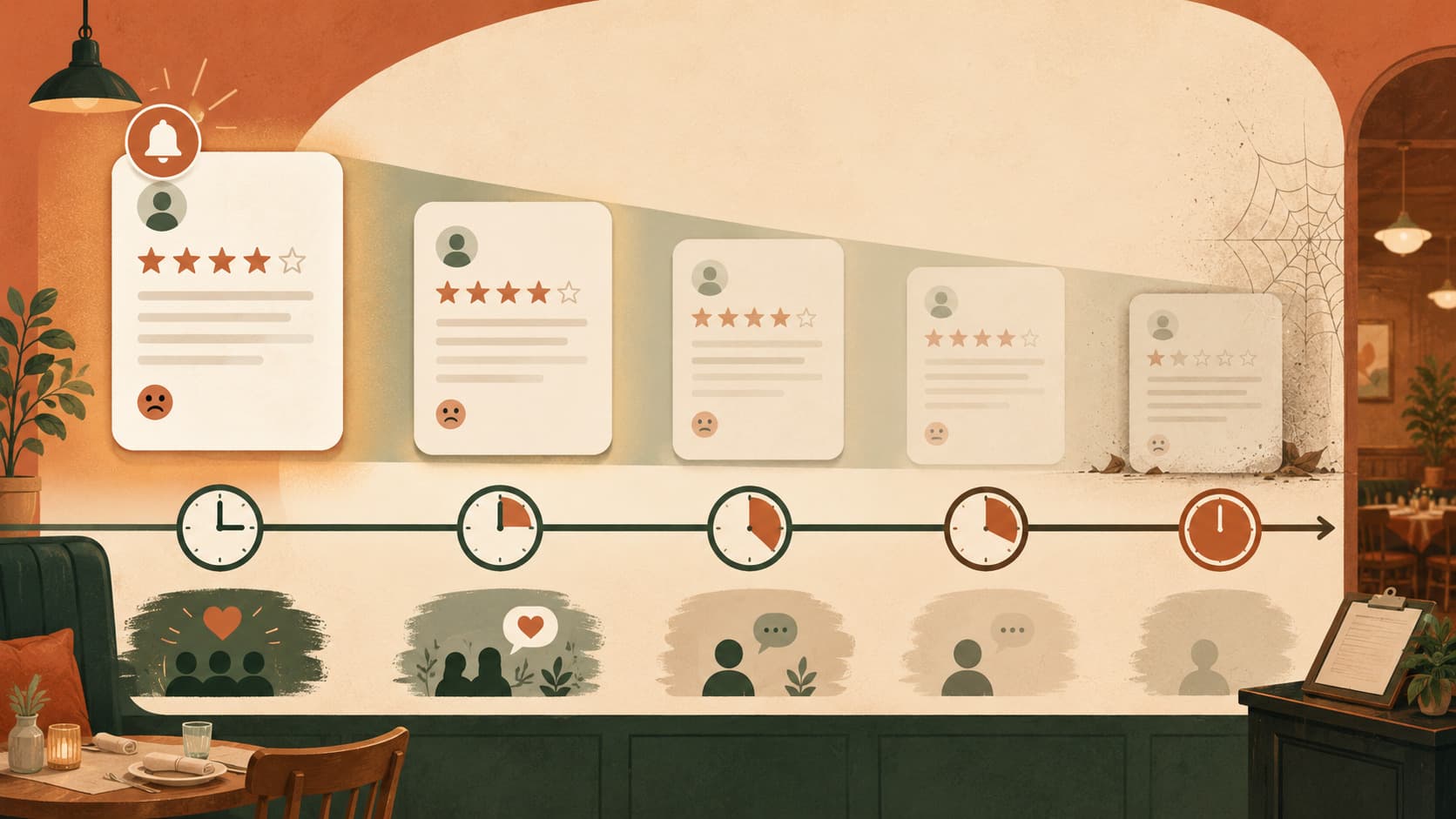
- Don't let the review sit alone at the top of your list: restart collecting genuine reviews. A suspicious review buried in a recent, active flow carries far less weight than an isolated one on a rarely-updated profile.
- Don't buy positive reviews to compensate. That's exactly the prohibited practice described above, and it exposes you to the same risks you're reporting.
For the full subject on managing reviews, see the complete guide to Google reviews for restaurants. For collecting genuine reviews at volume, see 12 legal ways to get more Google reviews.
SEOresto monitors your rating and new reviews continuously, making it easy to spot unusual activity quickly. From €39/month. See pricing.
Sources: Google's official review policies · FTC Rule on the Use of Consumer Reviews and Testimonials.
Author: Dmitrii Portnov, founder of SEOresto. This article provides general information and is not legal advice.