How Many Reviews to Rank in the Local Top 3?
Updated on 24 August 2026
There's no universal threshold. One restaurant can rank in the top 3 with 40 reviews in a small town, while another stays invisible with 200 reviews in a dense city neighbourhood. The only benchmark that matters is the average of the three businesses already ranking ahead of you on your main query, in your area.
The 5-minute method
- Open a private/incognito window (so your search history doesn't skew the results).
- Search your target query exactly as a customer would type it: "Thai restaurant Brooklyn", not "authentic Thai fine dining Brooklyn New York".
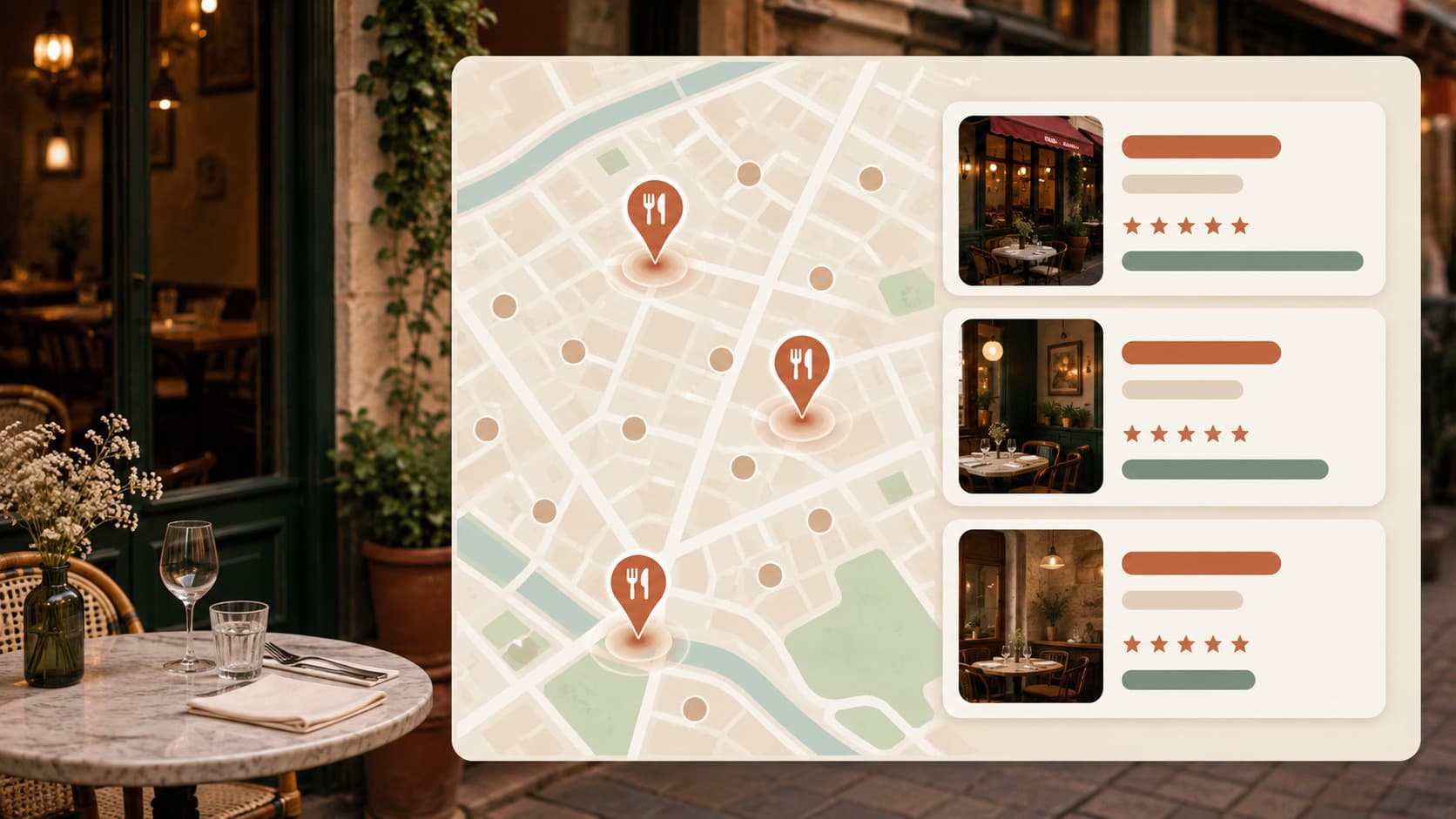
- Note the review count and rating of the three businesses in the Local Pack — the block of three with the map, at the very top.
- Average the review counts. That's your volume target.
- Note the lowest rating of the three. That's your quality floor.
Repeat this for 2–3 related queries ("Thai food Brooklyn", "cheap Thai Brooklyn"): the target usually converges on a stable range.
Why volume alone isn't enough
Local ranking combines several signals, and reviews are only part of it — roughly 17% according to industry analysis, alongside listing relevance, distance, and how active the profile is (photos, posts, updates).
Two restaurants with the exact same review count can rank differently if one responds consistently and the other never does, or if one gets new reviews every week and the other hasn't had one in six months.
What real cases show
| Context | Observed order of magnitude |
|---|---|
| Neighbourhood spot, mid-size city, low competition | Top 3 reachable at 30–60 reviews with a rating ≥ 4.3 |
| Dense district of a major metro area, high competition | Often 150–300+ reviews needed for the same result |
| High-density tourist area | Quality floor matters more than raw volume |
These numbers aren't universal benchmarks — they're orders of magnitude that illustrate why the local measurement method above is more reliable than a generic target.
What to do if the gap is large
If your three competitors average 180 reviews and you have 25, don't try to close the gap in a few weeks — that would read as unusual activity to Google. A steady pace of 10 to 20 new reviews a month, sustained over time, gradually closes the gap without triggering detection.
Full detail on compliant collection methods is in 12 legal ways to get more Google reviews.
For the full subject on local ranking, see local SEO for restaurants: the complete guide.
SEOresto tracks your position against your direct competitors and automatically restarts review collection when you fall behind. From €39/month. See pricing.
Source: local ranking weight breakdown, 2026 industry analysis.
Author: Dmitrii Portnov, founder of SEOresto.